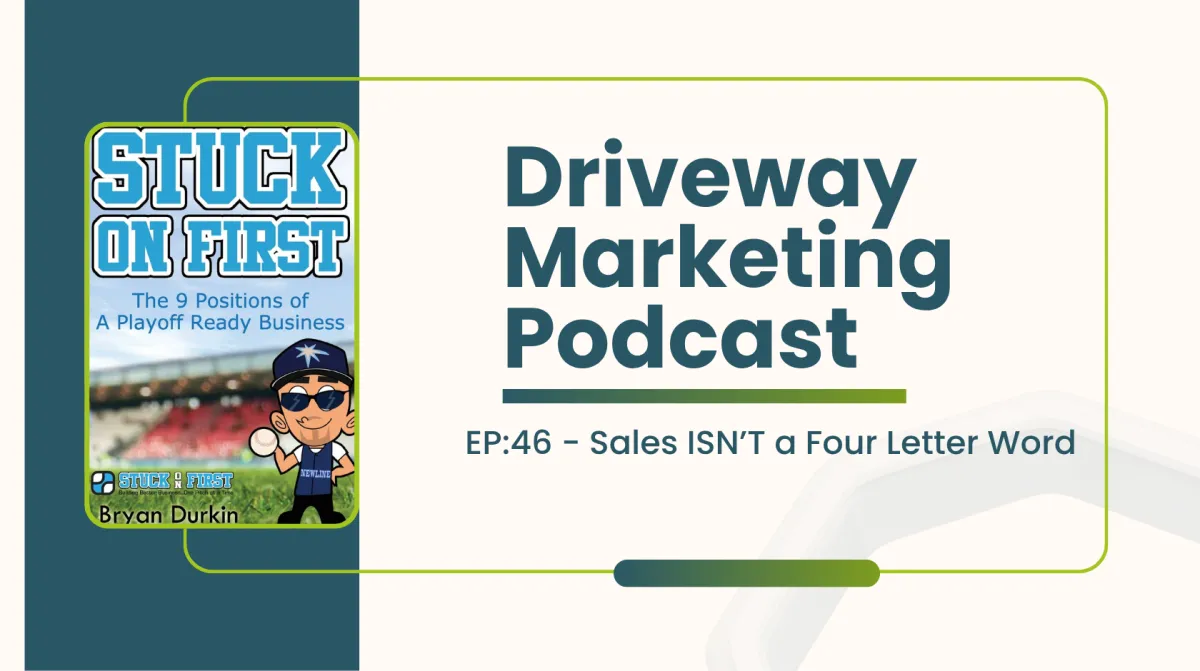
EP 46: Sales Isn’t a Four Letter Word: A Better Sales Process for Business Owners
A lot of owners get this wrong. They say they hate sales, but what they really hate is pressure, manipulation, and the fake, performative version of selling they have seen too many times. That is the real issue.
Sales itself is not the problem. Sales is how value gets transferred. Sales is how a business grows. Sales is how a customer gets a real solution instead of staying stuck with the same expensive problem.
If you believe in what you do, and you know it helps the right people, then selling is not something to apologize for. It is part of your responsibility as an operator. And if you want to build a business with margin, consistency, and scalability, you need a sales process that is built on trust, clarity, and follow-through.
This article sits right in line with the broader conversations we have on the Driveway Marketing Podcast, especially around Bryan’s Five Laws of Selling, referral-driven growth, and how consistency and authenticity actually drive business growth.
What People Actually Mean When They Say They Hate Sales
Most people do not hate sales. They hate being sold to badly.
They hate feeling cornered. They hate gimmicks. They hate the sense that someone is trying to win the transaction without caring whether the outcome is right for the buyer.
That baggage is real. But if you let that baggage define your approach, you create a new problem: you avoid selling altogether. Then the business starts relying on luck, referrals with no structure, or inconsistent word-of-mouth. That is not a strategy. That is drift.
Strong operators understand the distinction. Manipulation is about extracting value. Sales, done right, is about creating value and helping someone make a good decision.
Once you separate those two things, your posture changes. You stop acting like selling is beneath you. You start treating it like a core business function.
If You Cannot Explain the Value, You Will Never Sell with Confidence
Confidence in sales does not come from hype. It comes from clarity.
You need to know what you do, who you do it for, and what outcome your work creates. If you are fuzzy on any of those, your sales conversations will feel awkward because you are trying to compensate for weak positioning with effort.
Customers do not buy your years in business. They do not buy your process map. They do not buy your features in isolation. They buy what your solution makes possible.
Focus on the transformation, not the résumé
People care about outcomes. They want to know whether you save them time, reduce risk, improve results, create peace of mind, or make their operation run better. That is what matters commercially.
When owners lead with credentials instead of outcomes, they force the buyer to do too much interpretive work. A better sales process makes the value obvious.
This is also why strong positioning matters so much. If you need help tightening that part of the business, there is a useful parallel in scaling business through better sales systems and in elevating your marketing and sales together. Sales gets easier when the message is clear.
Trust Is the Real Sales Advantage
Trust is not a soft concept. It is a commercial advantage.
When a buyer trusts you, friction drops. Price resistance drops. Comparison shopping often drops. The conversation gets cleaner because the buyer believes you are being straight with them.
Trust is built in small moments:
Showing up when you said you would
Following through when you promised you would
Being honest about what you know and what you do not know
Not overstating the result
Not forcing a fit when it is not there
A lot of owners think trust is built by sounding polished. It is not. Trust is built by being reliable.
Saying “I don’t know” can strengthen the sale
One of the fastest ways to destroy trust is pretending to know something you do not. A better move is simple: say, “I don’t know, but I’ll get the answer and follow up.”
That kind of honesty signals maturity. It tells the buyer you are not winging it. It tells them your business has accountability.
And accountability is what separates professionals from amateurs.
Sales Is a Process, Not a Personality Trait
Here is another myth that slows down a lot of good businesses: “I’m just not a natural salesperson.”
That is usually an excuse built on a bad definition of sales. If you think sales means being charismatic, aggressive, or unusually persuasive, then yes, a lot of owners will opt out. But that is not what a real sales process looks like.
Sales is structure. Sales is preparation. Sales is qualification. Sales is follow-up. Sales is consistency over time.
This is not a personality problem. It is a systems problem.
What a repeatable sales process actually includes
Clear qualification so you know who is a fit
Preparation before the conversation starts
A simple framework for understanding needs and desired outcomes
Honest recommendations
Consistent follow-up after the first conversation
Documentation so opportunities do not disappear into memory
Charisma can help. But charisma without structure is unpredictable. Consistency wins because it compounds.
If this idea resonates, it connects well with embracing automation for efficiency and building systems for business success. Better operators do not rely on memory and mood. They build repeatable process.
Most Sales Are Lost Because Owners Quit the Follow-Up Too Early
One of the biggest mistakes I see is this: an owner has one decent conversation, sends one proposal, and then disappears when the buyer does not respond immediately.
That is not a sales strategy. That is impatience.
Your prospect is not living on your timetable. They have competing priorities, internal distractions, budget questions, and a business of their own to run. If you are not willing to follow up professionally and persistently, you will lose deals you should have won.
Pleasant persistence is not pressure
There is a difference between being annoying and being top of mind. Good follow-up adds value. It reminds the buyer you are still here. It shows professionalism. It keeps the conversation moving without forcing it.
Sometimes the sale happens because you stayed present long enough for timing to catch up with need.
That is why referral and relationship-based growth works so well when it is backed by process. You can see that same principle in the long game of referral growth and customer retention strategies that compound over time.
You Do Not Need More Noise. You Need Better Sales Activity.
A lot of businesses confuse motion with traction. They blast out messages, chase random leads, post without a plan, and call it sales effort. It is not.
You do not necessarily need more leads. You may need better leads, better qualification, and better conversations.
Sometimes a business does not need a hundred new opportunities. It needs a smaller number of the right opportunities handled with discipline.
That means:
Targeting the right people
Understanding the problem you solve
Showing up with relevance
Following up with consistency
Staying visible by sharing value instead of noise
This is where market position starts to improve. Not because you got louder, but because you got clearer.
If you want another angle on this, leveraging SEO, mobile, and reviews and using LinkedIn strategically for B2B growth both reinforce the same idea: visibility only matters when it supports a real system.
What Better Operators Do Differently in Sales
Better operators do not treat sales like a necessary evil. They treat it like a discipline.
They understand that selling is not about pushing. It is about diagnosis, communication, trust, and implementation.
Here is what they do differently:
They believe in what they sell
They can clearly explain the value
They qualify instead of chasing everyone
They tell the truth, even when the answer is “not yet” or “not a fit”
They follow up without disappearing
They build process instead of relying on personality
That is how a business creates consistency. That is how trust turns into revenue. That is how sales stops feeling heavy.
And if you are serious about sharpening this part of the business, spend time in the Driveway Marketing Podcast blog and consider applying to be a podcast guest if you have real operator insight to share.
The Bottom Line on Why Sales Isn’t a Four Letter Word
Sales isn’t a four letter word. Bad sales is the problem. Weak structure is the problem. Avoidance is the problem.
If your offer genuinely helps people, then selling it with clarity and conviction is not something to feel awkward about. It is part of leading the business well.
So stop making sales emotional. Make it operational.
Know your value. Build trust. Create a repeatable process. Follow up like a professional. Stay visible by being useful.
Do that, and you will be ahead of a lot of businesses that are still confusing activity with execution.
Ready to tighten your sales process and grow with more consistency? Start by reviewing your current sales conversations, your follow-up rhythm, and how clearly you communicate value. Then go fix the weak points. That is where the growth is.
Frequently Asked Questions
Why do so many business owners dislike sales?
Most owners do not dislike sales itself. They dislike manipulation, pressure, and inauthentic tactics. When sales is reframed as helping the right customer make a good decision, it becomes far more effective and far less uncomfortable.
What does authentic sales actually mean?
Authentic sales means being clear about the value you provide, honest about fit, and reliable in your follow-through. It is trust-based selling, not pressure-based selling.
Is sales a personality trait or a process?
Sales is a process. Personality can help, but structure matters more. Qualification, preparation, communication, and follow-up are what make sales repeatable.
How can I improve sales confidence as a business owner?
Start by getting clear on who you help, what problem you solve, and what outcome you create. Confidence comes from clarity, not hype. When you know your value, sales conversations get easier.
How important is follow-up in the sales process?
It is critical. Many deals are lost because owners stop following up too early. Professional, value-driven follow-up keeps you top of mind and gives timing a chance to align with need.
Connect With Bryan Durkin
Follow Bryan Durkin on Facebook
Connect with Bryan Durkin on LinkedIn
