EP 53: AI Visibility Without the Founder Bottleneck
AI already has an opinion about your business. The question is whether that opinion is accurate, useful, and strong enough to put you in front of a serious buyer.
AI visibility is the degree to which artificial intelligence platforms can accurately identify, understand, trust, and recommend you or your business. It is built through consistent information, credible proof, authentic content, technical clarity, and a body of work that makes your market position obvious.
A lot of owners get this wrong. They assume their website, social profiles, and years in business automatically make them visible. Then they ask ChatGPT, Gemini, Claude, or another AI platform about the company and discover missing information, confused identities, outdated positioning, or competitors appearing where they should.
That is the real issue. Your buyers are using AI to research problems, compare providers, and decide who deserves further consideration. If the systems cannot understand what you do, they cannot represent you correctly.
AI Already Has an Opinion About You, reinforces the central point: refusing to participate does not leave your reputation untouched. It leaves the narrative open for machines to assemble without your direction.
Start Your AI Visibility Strategy With an Invisible Audit
The first move is not buying another tool or publishing another pile of generic articles. Start with an invisible audit.
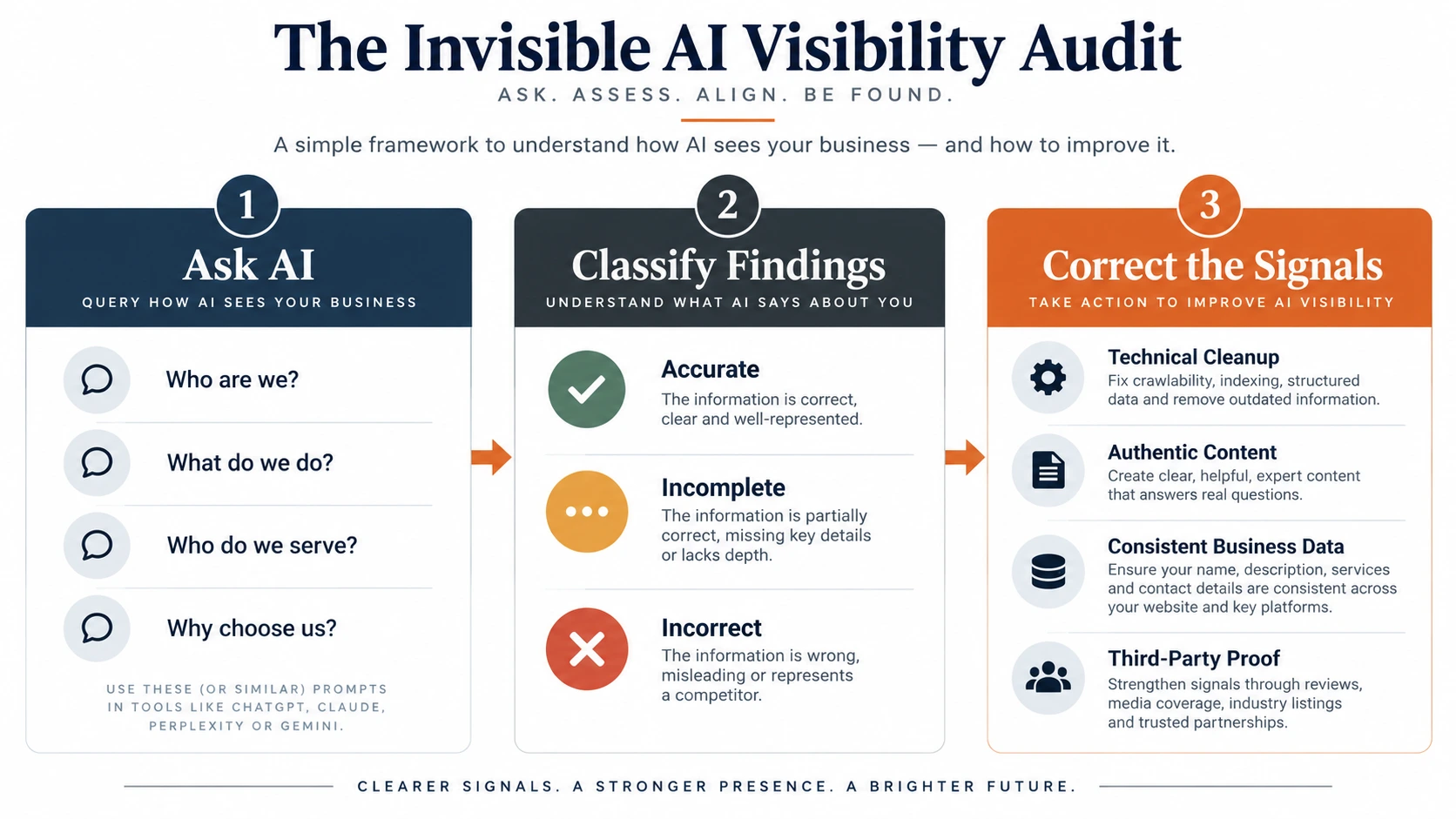
An invisible audit is a structured check of what AI platforms currently know, infer, and communicate about you. Open the AI model of your choice and ask direct questions:
Who is [your name], and what is this person known for?
What does [business name] do?
Who does the company serve?
What services or products does it provide?
Why would someone choose this company over its alternatives?
Is this business associated with any other companies, locations, or people?
Do not ask one flattering question and declare victory. Test variations. Use your full name, company name, location, specialty, and the language a buyer would naturally use. Run the same questions across multiple platforms because different models may interpret your digital footprint differently.
Then sort the results into three categories: accurate, incomplete, and incorrect. That gives you an operational starting point rather than another vague discussion about “doing more AI.”
Why AI Gets Your Business Wrong
When AI returns a weak or inaccurate answer, two problems are usually worth investigating: technical confusion and insufficient evidence.
Technical confusion weakens trust
Your digital footprint may contain abandoned landing pages, old phone numbers, incomplete service descriptions, leftover website templates, inconsistent company names, or pages referring to products you no longer sell. A local business may also have an incomplete Google Business Profile or inconsistent location information.
Those details are not harmless clutter. They create conflicting signals. When your website says one thing, a directory says another, and an old landing page introduces a third version, the systems interpreting your business have to decide which source deserves trust.
This is not a marketing problem. It is a systems problem.
For local operators, the basics still matter. Your Google Business Profile should be complete, your location and contact details should be consistent, and your business should publish relevant updates and proof. The earlier breakdown of SEO, mobile visibility, and reviews provides useful context for strengthening those foundational signals.
Insufficient evidence creates a proof gap
The second problem is a lack of meaningful material. If your company has said very little publicly, AI has very little to work with. It may find a thin service page and a few directory listings, but that does not establish what you believe, how you solve problems, or why your perspective deserves attention.
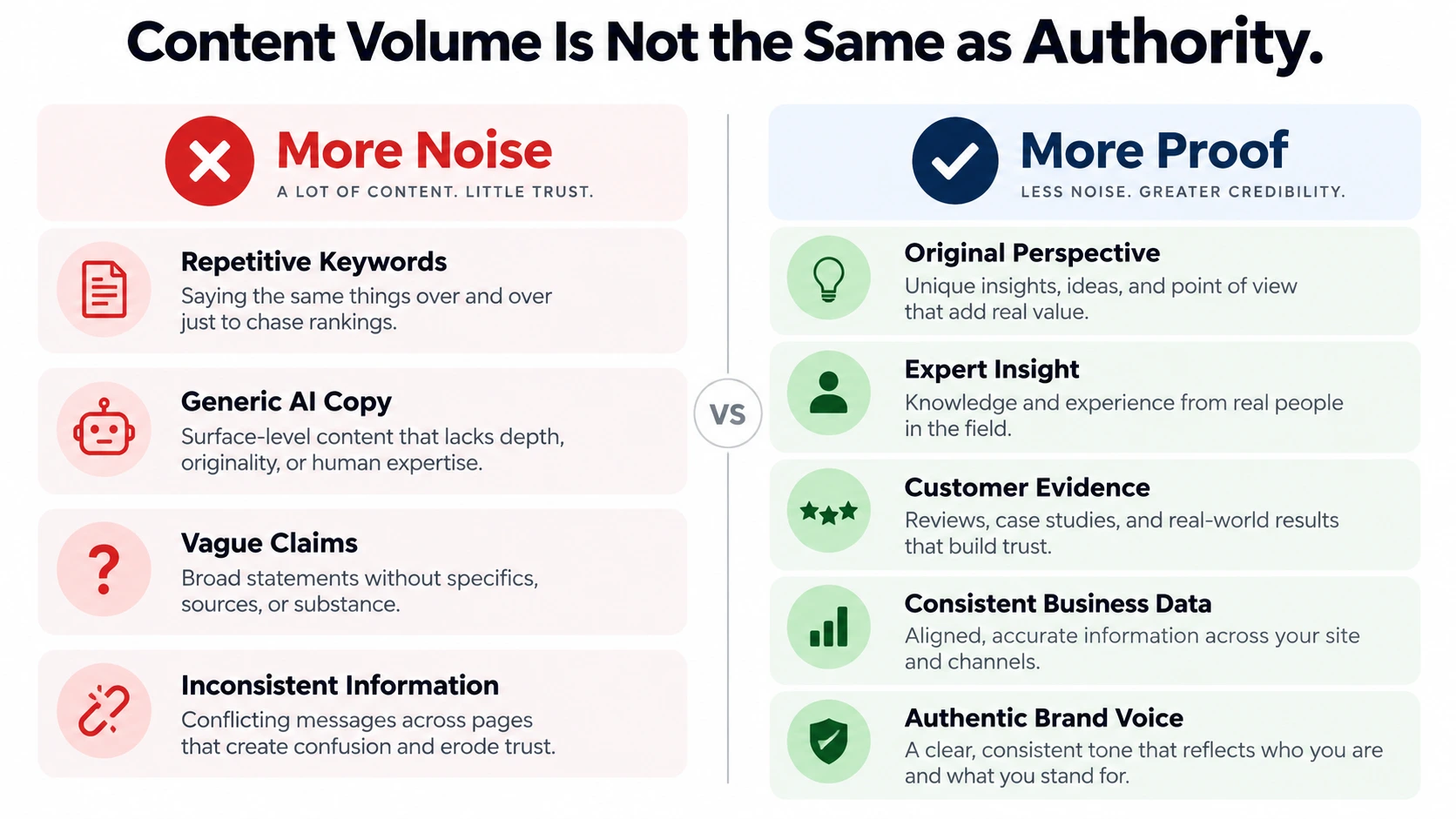
The answer is not keyword stuffing. Publishing repetitive content designed only to mention a phrase does not create authority. Trust comes from a coherent body of work supported by clear expertise, consistent positioning, real experiences, and credible proof.
For a deeper discussion of how authority and trust now shape modern marketing, see Authenticity, Authority, Trust, Marketing, and AI.
AI Visibility Depends on Proof, Not Content Volume Alone
The old playbook rewarded companies for producing large amounts of keyword-driven content. That created an internet full of pages written to rank rather than help. AI-generated filler has made the problem worse.
Better operators close the proof gap. They create material that demonstrates:
what the business knows
who the business serves
how the team thinks about customer problems
what makes its process or perspective different
whether the company communicates consistently
whether other credible sources support its claims
Authenticity matters because authority cannot be manufactured from generic language. Your stories, distinctions, examples, terminology, and point of view give search engines and AI systems something specific to associate with your name.
That does not mean AI cannot support the process. It can help organize, edit, repurpose, and distribute what you know. It should not erase the person behind the knowledge. I address that distinction directly in Authenticity Beats AI Fluff.
The strategic goal is not to sound polished enough to impress an algorithm. The goal is to become clear enough that humans and machines understand why you matter.
The Founder Should Not Carry the Entire Brand
Many businesses have enough expertise to publish valuable content. Their problem is that all of it is trapped inside the founder.
The founder approves every idea, appears in every video, explains every service, and becomes the only source of market-facing knowledge. Content slows down because the person with the least available time is responsible for the entire system.
This is where the business starts paying for weak structure.
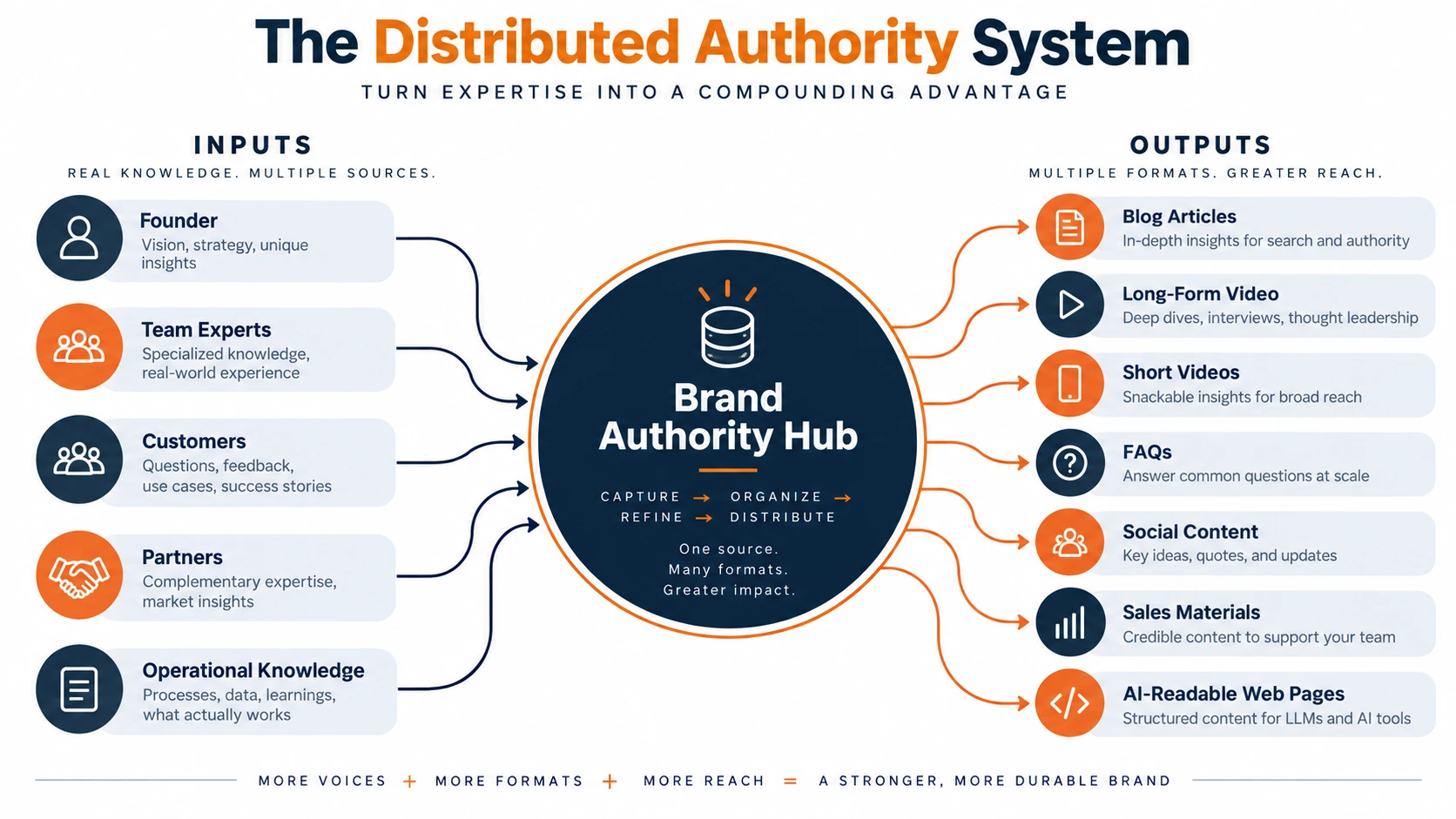
If the founder enjoys creating content and can do it consistently, that is useful. If not, stop pretending the company has no other voices. A project manager may understand implementation better. A technical leader may be able to explain common failures. A salesperson may know the objections buyers raise every week. Customers can describe the experience from the other side of the table. In some companies, a spouse or operating partner understands the business more deeply than anyone realizes.
The job is to identify the people who hold useful knowledge and build a system that captures it. I explain the leadership version of this problem in The Power of Delegation and Structured Leadership.
Also, the short video The Founder Bottleneck makes the same point in direct terms: if everything depends on the founder, the company does not have scalable authority. It has one overextended spokesperson.
Build an Authority System Around the Business
The solution is not removing the founder from the brand. The solution is making sure the brand can communicate without waiting for the founder every time.
A practical authority system can include five parts:
Define the position. Decide what the company and its key people should be known for.
Identify internal experts. Map the team members, partners, customers, and stakeholders who can contribute credible knowledge.
Capture authentic source material. Use interviews, recorded conversations, customer questions, presentations, and operating discussions.
Repurpose with control. Turn the source material into articles, videos, short clips, FAQs, social posts, and sales enablement content while preserving the original voice.
Audit consistency. Review websites, profiles, directories, content, and AI answers to find contradictions or gaps.
That is how authority becomes a business asset rather than a founder-dependent activity. A recent episode The AI Free-for-All Is Costing You Money expands on why random AI activity creates operational drag unless it is connected to a real system.
The technical side matters too. Content must be structured so machines can identify the company, people, topics, services, and relationships behind it. You Need to Be Machine Readable, shows why strong ideas still need a clear digital structure.
A Practical 30-Day AI Visibility Plan
You do not need to rebuild your entire digital presence tomorrow. You do need to stop treating the problem as theoretical.
Week 1: Run the invisible audit
Ask several AI platforms what they know about you, your company, your services, and your market position. Save the answers and classify each finding as accurate, incomplete, or incorrect.
Week 2: Fix conflicting business information
Review your website, Google Business Profile, major directories, service pages, landing pages, phone numbers, company descriptions, and leadership information. Remove abandoned pages and correct conflicting details.
Week 3: Capture real expertise
Record one focused conversation with the founder or another internal expert. Answer common buyer questions, explain a costly misunderstanding, or describe what separates strong implementation from weak implementation.
Week 4: Publish and distribute the source material
Turn that conversation into a useful article, a long-form video, short clips, FAQs, and sales content. Keep the point of view intact. Consistent repurposing creates leverage; disconnected content creates noise.
For a broader look at building authority specifically for AI-driven discovery, the episode Who Owns Your AI Visibility? is the logical next step.
Take action now: run your first invisible audit, document what AI gets wrong, and assign ownership for correcting it. If no one owns AI visibility inside the business, it will remain inconsistent by default.
Frequently Asked Questions
What is AI visibility?
AI visibility is the ability of artificial intelligence platforms to accurately identify, understand, trust, and potentially recommend a person or business. It depends on consistent data, credible proof, authentic content, and clear digital structure.
How do I audit what AI knows about my business?
Ask multiple AI platforms who you are, what your company does, who it serves, and what it is known for. Classify each answer as accurate, incomplete, or incorrect, then trace the problems back to your website, profiles, directories, and content.
Why does AI show incorrect information about a company?
Incorrect answers can come from conflicting phone numbers, outdated pages, similar company names, incomplete profiles, abandoned templates, weak content, or insufficient third-party proof. Conflicting signals make the business harder to interpret and trust.
Does the founder need to create all authority content?
No. The founder can define the position without producing every asset. Team experts, customers, partners, project managers, and other credible voices can contribute source material within a controlled brand system.
Can AI-generated content improve AI visibility?
AI can help organize and repurpose authentic expertise, but generic AI-generated copy is not a substitute for proof or perspective. Start with real knowledge and use AI to create leverage without erasing the brand’s voice.
How often should a business check its AI visibility?
Check it regularly and after major changes to services, leadership, locations, positioning, or website structure. The goal is to make AI visibility part of ongoing brand governance rather than a one-time marketing task.
Own the Narrative Before AI Owns It for You
Your buyers are already researching with AI. Your competitors, suppliers, industry publications, directories, and old website pages may all influence what those systems say about you.
You cannot control every answer. You can control the quality, consistency, and credibility of the evidence available.
Run the invisible audit. Correct the technical leaks. Publish authentic expertise. Build a distributed content system so the founder is not carrying the entire brand. Then repeat the process with accountability.
AI visibility is not another campaign to bolt onto the business. It is part of how modern authority is built, interpreted, and discovered. Treat it like an operating system, not a trend.
Connect With Bryan Durkin
Follow Bryan Durkin on Facebook
Connect with Bryan Durkin on LinkedIn
Subscribe to Bryan Durkin on YouTube
Listen to Bryan Durkin on Spotify
