EP 54: Who Owns Your AI Visibility? Build Authority for AI Search
If a buyer asks ChatGPT, Google AI, Claude, or Perplexity about the product or service you sell and the platform recommends your competitor instead, who inside your company knows it happened?
For most businesses, the answer is nobody.
That is the real issue. AI visibility is not simply another marketing channel or website project. It is an ownership problem involving operations, sales, marketing, publishing, authority, and accountability. If nobody owns the connections between those functions, AI platforms have a harder time understanding, verifying, citing, and recommending your business.
This shift also reinforces a broader reality explored in Authenticity, Authority, Trust, Marketing, and AI: businesses do not become trusted by publishing generic information. They become trusted by turning real expertise, evidence, and market perspective into content that both humans and machines can understand.
AI Visibility Is an Ownership Problem
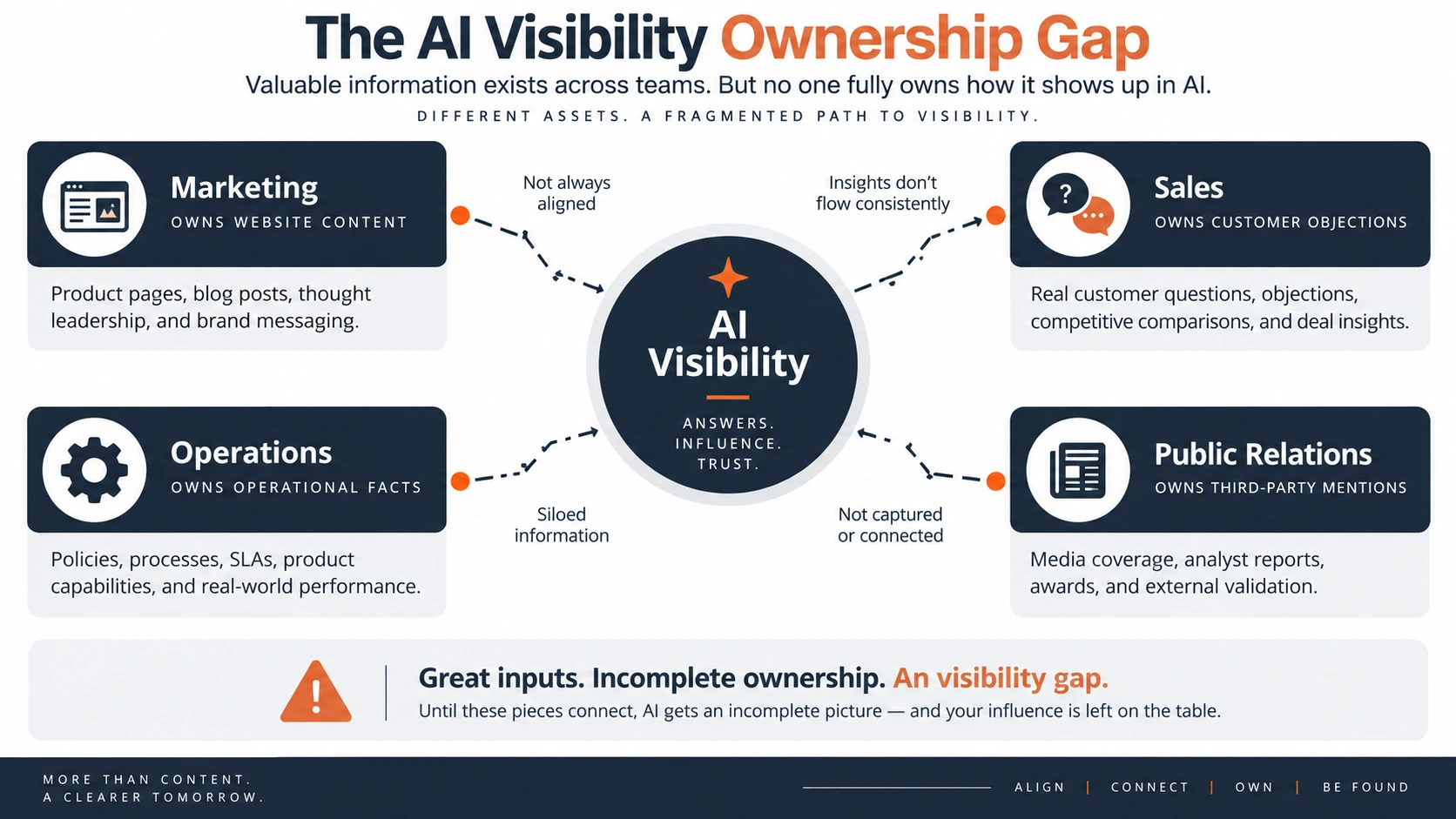
Most companies already possess the information required to build authority in AI search. The problem is that the information is fragmented across the business.
Marketing owns the website but may not own the operational facts or real customer questions.
Sales knows the objections, buying concerns, competitive differences, and proof that move decisions forward.
Operations knows the specifications, capabilities, lead times, service limitations, certifications, and implementation realities.
Public relations may control publications, media placements, podcast appearances, and other third-party mentions.
Everyone can be doing a competent job while the company still remains nearly invisible to answer engines. There is no handoff between the people who know the truth and the people responsible for publishing it.
This is not a marketing problem. It is a systems problem.
Traditional SEO Reports No Longer Tell the Whole Story
Keyword rankings, traffic, clicks, and website conversions still matter. The mistake is treating them as the complete scorecard.
Buyers are increasingly using answer engines to research companies, compare options, validate claims, and narrow their choices before visiting a website. The company may never see the original query. There may be no click to measure. The buyer can receive a summarized answer, form an opinion, and move forward with a competitor without appearing in your traditional reporting.
The game is moving from winning the click to earning the citation.
A citation means an AI platform considers your business, website, or supporting third-party sources reliable enough to reference in an answer. That requires more than occupying a search position. Your information must be clear, consistent, specific, and verifiable.
I recently broke down the operational danger of chasing tools without structure in The AI Free-for-All Is Costing You Money. The same principle applies here: random AI activity does not create a durable market position. A system does.
For the concise version of this shift, Placement Beats Volume explains why being present in the right trusted sources can matter more than producing another pile of undifferentiated content.
Your Website Must Become the Source of Record
Your website should be the company’s source of record: the clearest owned source for what you do, whom you serve, how you work, what you can prove, and where your limitations begin.
A lot of owners get this wrong. They assume a polished website automatically gives an AI engine what it needs. Visual presentation matters to human decision-makers, but clean design is not the same as machine-readable knowledge.
Answer engines need direct language, logical structure, descriptive headings, consistent facts, clear relationships, and answers to specific questions. Generic statements such as “we provide great service” or “we aim to please” offer almost nothing that can be verified or quoted.
Specificity creates authority. Explain what your team does differently, which problems you solve, how your process works, which qualifications support your claims, and what buyers should expect. If you cannot substantiate a statement, it should not be carrying your positioning.
The short video You Need to Be Machine Readable reinforces this point: your expertise cannot influence AI-generated answers if it remains buried in conversations, vague copy, or undocumented institutional knowledge.
Build Content From Real Sales and Operational Knowledge
Your best content topics are probably already sitting inside your business.
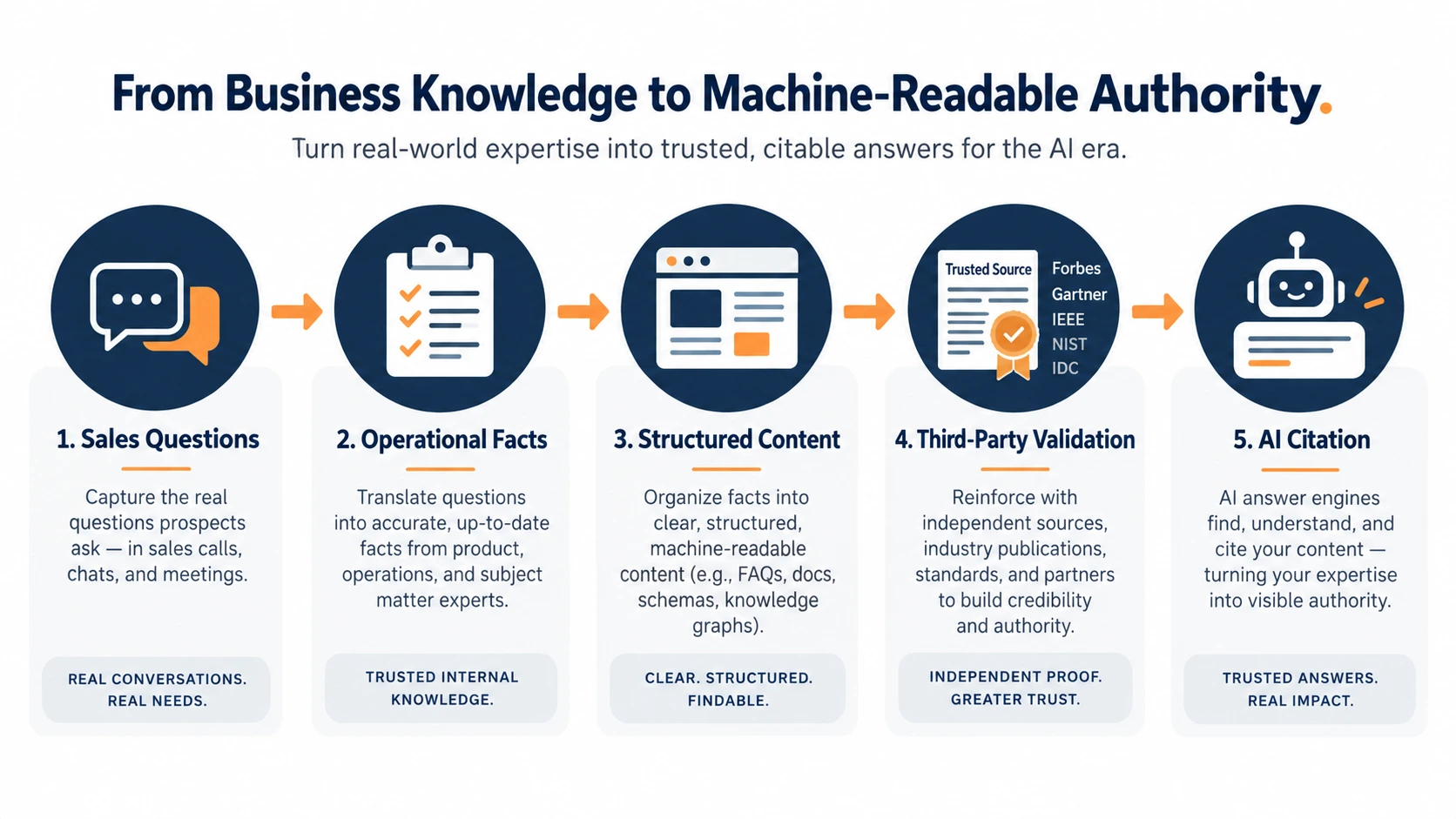
Start with the recurring questions and objections your sales team hears. What causes buyers to hesitate? What do prospects misunderstand? Which comparisons repeatedly come up? What proof helps a buyer feel confident? Those questions should become clear, useful content before the sales conversation happens.
Then bring in operations. Sales knows what buyers ask, but operations knows what the business can responsibly promise. That distinction matters. Authority content must reflect actual capabilities, not marketing language created in isolation.
Useful knowledge to document includes:
Common buying questions and objections
Service capabilities and limitations
Process explanations
Certifications and qualifications
Customer evidence and approved case studies
Service areas, locations, and availability
Changes in capabilities, staffing, or delivery
Clear comparisons between different options
The goal is not to manufacture more content. The goal is to document what the company genuinely knows in a form that can be understood, verified, and reused.
If this sounds operational rather than promotional, that is because it is. Building Systems for Business Success expands on why consistent execution depends on defined systems instead of founder memory and one-off effort.
Third-Party Authority Makes Your Claims Verifiable
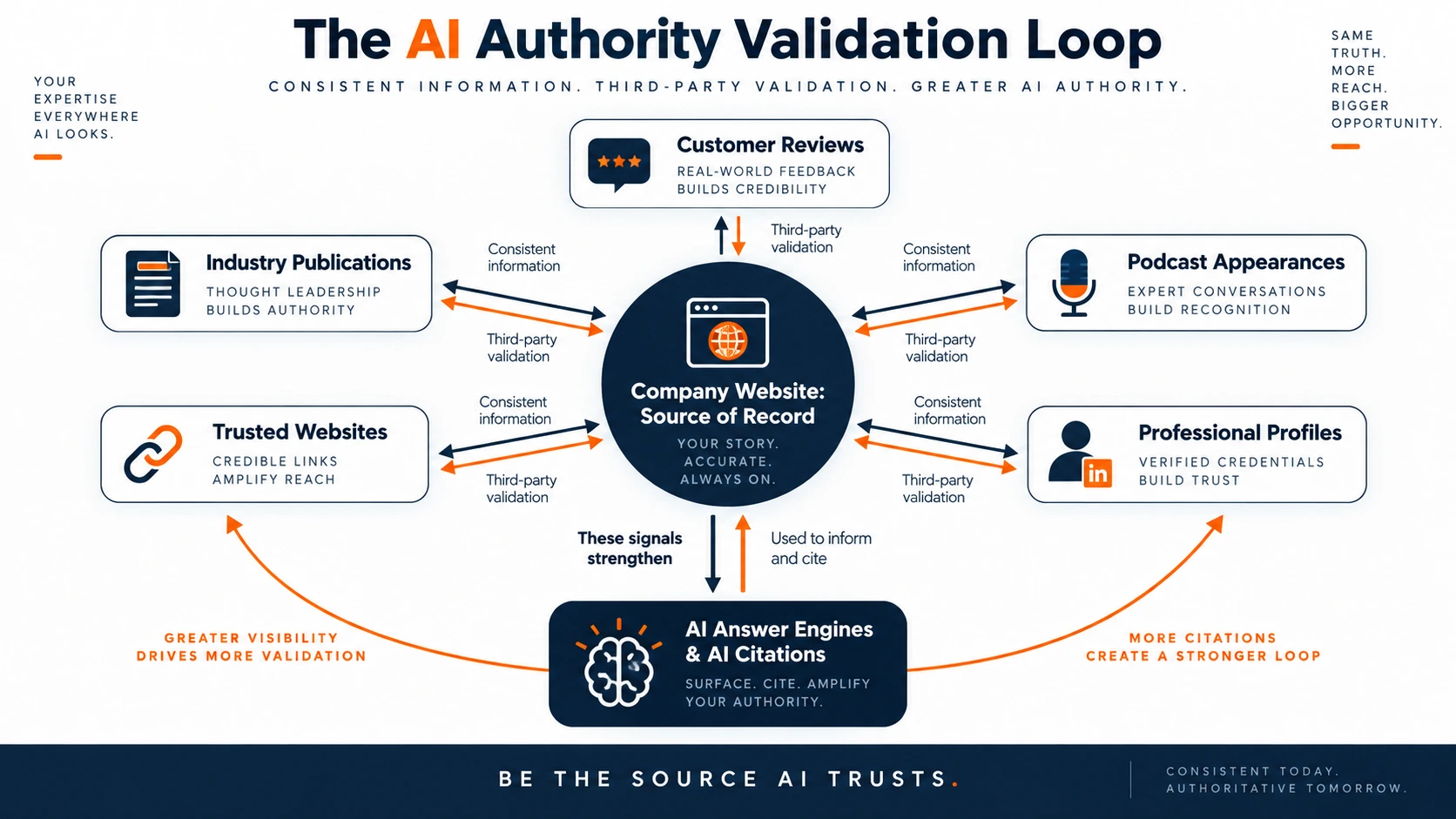
Your website can make a claim about your expertise. Third-party sources can help validate it.
Reviews, industry publications, trusted directories, interviews, podcast appearances, professional profiles, and relevant websites create an external authority layer. They give answer engines more context for deciding whether your company is a credible source.
This does not mean scattering the same generic article across dozens of platforms. Volume without relevance creates noise. Better operators pursue placements that reinforce a specific market position and connect back to a strong source of record.
Your authority should also sound like you. A clear point of view is easier to understand and remember than generic category language. Bryan explains the broader market shift in Authority-Driven Marketing Shift, including why credible expertise must become a central part of modern marketing strategy.
The Five-Part AI Visibility Ownership Map
AI visibility becomes manageable when ownership is explicit. Every company should assign responsibility across five areas.
1. Facts
Who owns the accurate information about services, capabilities, locations, specifications, qualifications, and limitations? This responsibility usually requires direct operational involvement.
2. Proof
Who captures the evidence supporting your claims? Proof may include customer feedback, approved case studies, certifications, documented processes, and other substantiated evidence.
3. Updates
Who communicates changes when the company adds a location, changes a process, introduces a capability, or updates its availability? Stale information weakens trust with buyers and machines.
4. Publishing
Who turns internal knowledge into structured content and distributes it across the website and relevant third-party platforms? Publishing must include quality control, consistency, and strategic placement.
5. Monitoring
Who checks what answer engines are saying about the company, its people, its services, and its category? Monitoring should identify inaccurate information, weak coverage, missing proof, and competitors receiving citations you should be earning.
Write those five areas down and assign a real owner to each one. They should not all be blank, and they should not all be outsourced without internal accountability. An outside partner can lead parts of the process, but the truth of the business still has to come from inside the business.
This ownership map is the difference between building authority intentionally and hoping your current marketing activity somehow produces the right answer.
Turn AI Visibility Into an Operating System
Do not begin by buying another tool. Begin with accountability.
Assign owners for facts, proof, updates, publishing, and monitoring.
Document the questions buyers already ask your sales team.
Validate every answer with operational knowledge.
Publish the answers in a structured, machine-readable format.
Build relevant third-party authority around those answers.
Monitor how major answer engines describe and recommend the business.
Correct gaps and repeat the process consistently.
This work is simple in concept and difficult in practice because it requires coordination. It is the long, disciplined road. That is also why it creates leverage. Most competitors will continue chasing isolated rankings, tools, and content volume instead of building the underlying structure.
For the larger distinction between disciplined implementation and disconnected experimentation, use AI Business Systems vs. Random Acts as the next step.
Action step: Schedule a 30-minute ownership meeting with sales, operations, and marketing. Put the five responsibilities on the screen, assign one accountable owner to each, and identify the first three buyer questions your company needs to answer properly. Do not leave the meeting with shared responsibility. Shared responsibility usually means no responsibility.
Frequently Asked Questions
What is AI visibility?
AI visibility is the extent to which answer engines can understand, verify, cite, and recommend a business when users ask relevant questions about its services, products, expertise, or market category.
Who should own AI visibility inside a company?
One accountable leader should coordinate AI visibility, but sales, operations, marketing, and publishing must contribute. The work depends on accurate facts, credible proof, timely updates, structured publishing, and ongoing monitoring.
Is AI visibility the same as traditional SEO?
No. Traditional SEO focuses heavily on rankings, traffic, and clicks. AI visibility also focuses on whether answer engines can interpret, verify, cite, and recommend the company, sometimes without generating a website visit.
How can a business improve its visibility in AI search?
Document real buyer questions, publish specific and machine-readable answers, maintain accurate business facts, build relevant third-party authority, and monitor what major AI platforms say about the company.
Why does third-party authority matter for AI search?
Third-party sources help validate what a company says about itself. Reviews, publications, podcasts, trusted profiles, and relevant websites provide external evidence that answer engines can use when evaluating credibility.
Should an outside agency own the entire AI visibility process?
No. An agency can support strategy, publishing, and monitoring, but internal teams must remain accountable for operational facts, proof, updates, and the accuracy of the company’s market claims.
Own the Answer Before a Competitor Does
AI visibility will not improve because someone redesigned the website, generated more articles, or added another dashboard. It improves when the business creates a system for turning accurate internal knowledge into clear, verifiable, and consistently published authority.
Your website must become the source of record. Your sales knowledge must become machine-readable. Your operational truth must shape your claims. Your third-party presence must validate your position. Someone must monitor what AI engines are actually saying.
The businesses that assign ownership now have a better chance of becoming the sources answer engines trust. The businesses that leave AI visibility sitting between departments will keep wondering why competitors own the answer.
Connect With Bryan Durkin
Follow Bryan Durkin on Facebook
Connect with Bryan Durkin on LinkedIn
Subscribe to Bryan Durkin on YouTube
Listen to Bryan Durkin on Spotify
