EP 52: 10 Business Lessons From the Podcast That Actually Build Growth
Most owners do not have an information problem. They have an implementation problem.
They know they should follow up better. They know referrals matter. They know customer experience affects retention. They know culture matters. They know AI is changing the landscape. But knowing it and structuring a business around it are two very different things.
That is the real issue.
In this episode, I looked back on years of conversations, operators, guests, and real-world business patterns and pulled out the 10 business lessons from the podcast that matter most. These are not motivational ideas. They are operating principles. If you run a service business or any growth-minded company, these are the lessons that tighten margin, improve consistency, and create a stronger market position.
If you want a related breakdown on how structure drives execution, start with Building Systems for Business Success. And if random AI usage is already creating confusion in your business, I go deeper in AI Business Systems vs Random Acts.
Consistency Beats Creativity Every Time
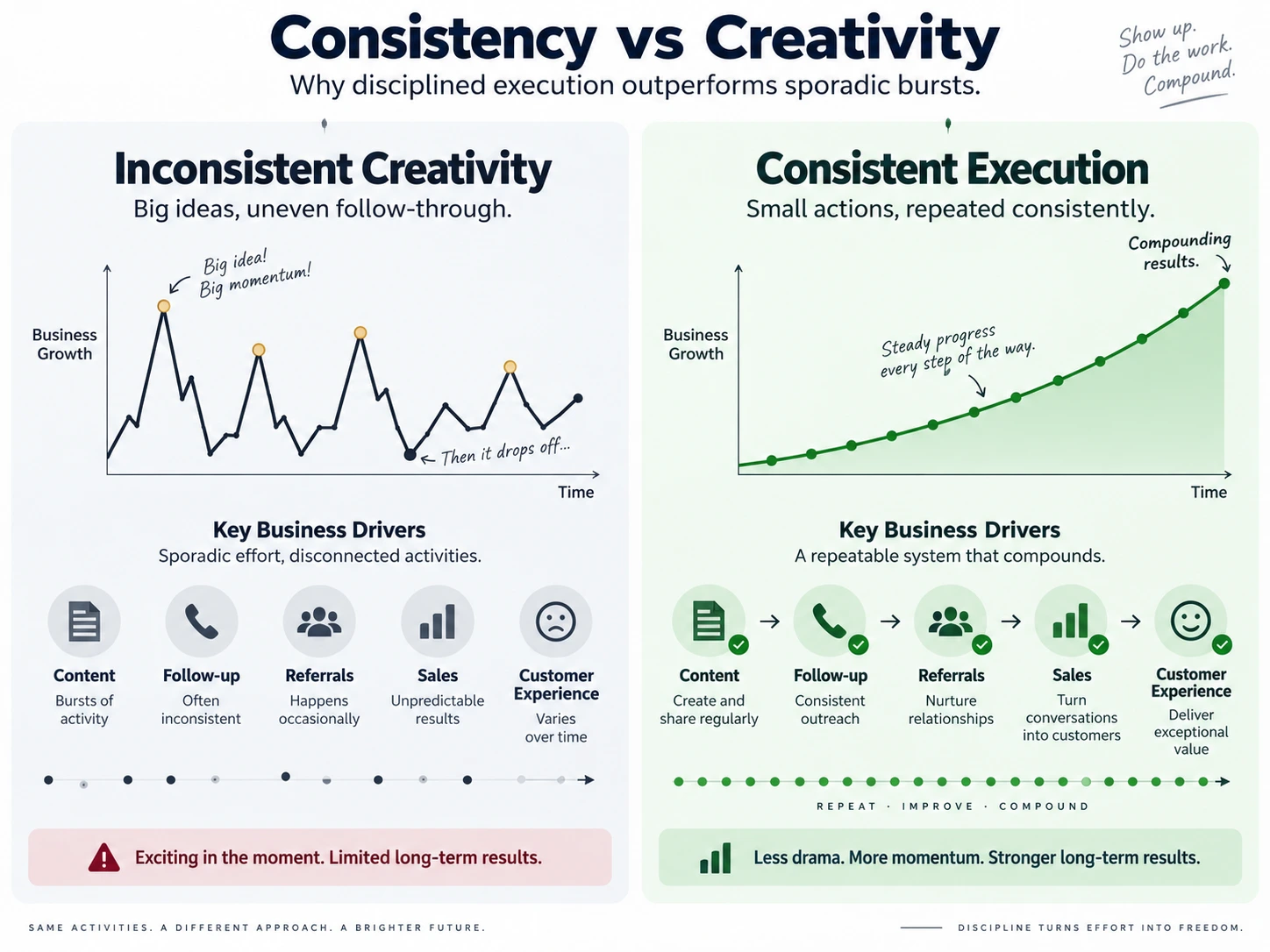
A lot of owners get this wrong. They keep looking for the clever campaign, the viral post, the perfect idea, or the breakthrough tactic. Meanwhile, the business that wins is usually the one that keeps showing up.
Consistency is operational leverage. It compounds. Consistent follow-up compounds. Consistent content compounds. Consistent outreach compounds. Consistent delivery compounds.
Creativity has value, but only after consistency is in place. Without consistency, creativity becomes entertainment. With consistency, creativity becomes acceleration.
The long game wins because trust is built through repetition. That is true in sales, marketing, leadership, and authority-building.
I make a similar point in The Power of the List and Why 41 - 39 - 20 Wins, where disciplined execution matters more than random activity and in Consistency is King.
Most Businesses Do Not Have a Lead Problem. They Have a Follow-Up Problem.
This one is expensive because owners keep trying to solve it with more ad spend.
If your follow-up is weak, more leads do not fix the problem. They magnify it. You just create more waste inside a broken system.
Not every prospect is ready to buy today. Some are ready now. Some are moving toward a decision. Some may buy later. Some never will. Good operators understand that opportunity moves in stages, and follow-up is the system that moves people through those stages.
Meaningful follow-up is not random checking in. It is structured, relevant, and ongoing. It provides value. It keeps the business top of mind. It creates trust before urgency shows up.
This is not a marketing problem. It is a systems problem.
For a deeper look at why the list and the follow-up sequence matter so much, read Power of the List: 40-40-20 Marketing. And take a look at Better Leads Beat More Leads.
Selling Should Feel Like Diagnosis, Not Manipulation
Weak sales feels pushy because it is disconnected from the actual problem. Strong sales feels helpful because it is rooted in diagnosis.
When you understand the buyer’s situation, constraints, timing, and desired outcome, the sales conversation changes. You are no longer trying to force a close. You are helping someone understand what is actually broken and what it will take to fix it.
That is why selling should not feel like pressure. It should feel like clarity.
If the prospect has a follow-up issue, say that. If they have a positioning issue, say that. If they are trying to buy leads when their close process is weak, say that too. Good operators do not hide from the diagnosis because the diagnosis is what creates trust.
I dive deeper in this philosophy in Bryan’s Five Laws of Selling and in the video My Five Laws of Selling. The short version is just as direct in Stop Selling, Start Helping #shorts.
Referrals Should Never Be Left to Chance
If referrals are one of your biggest revenue sources, then they deserve structure.
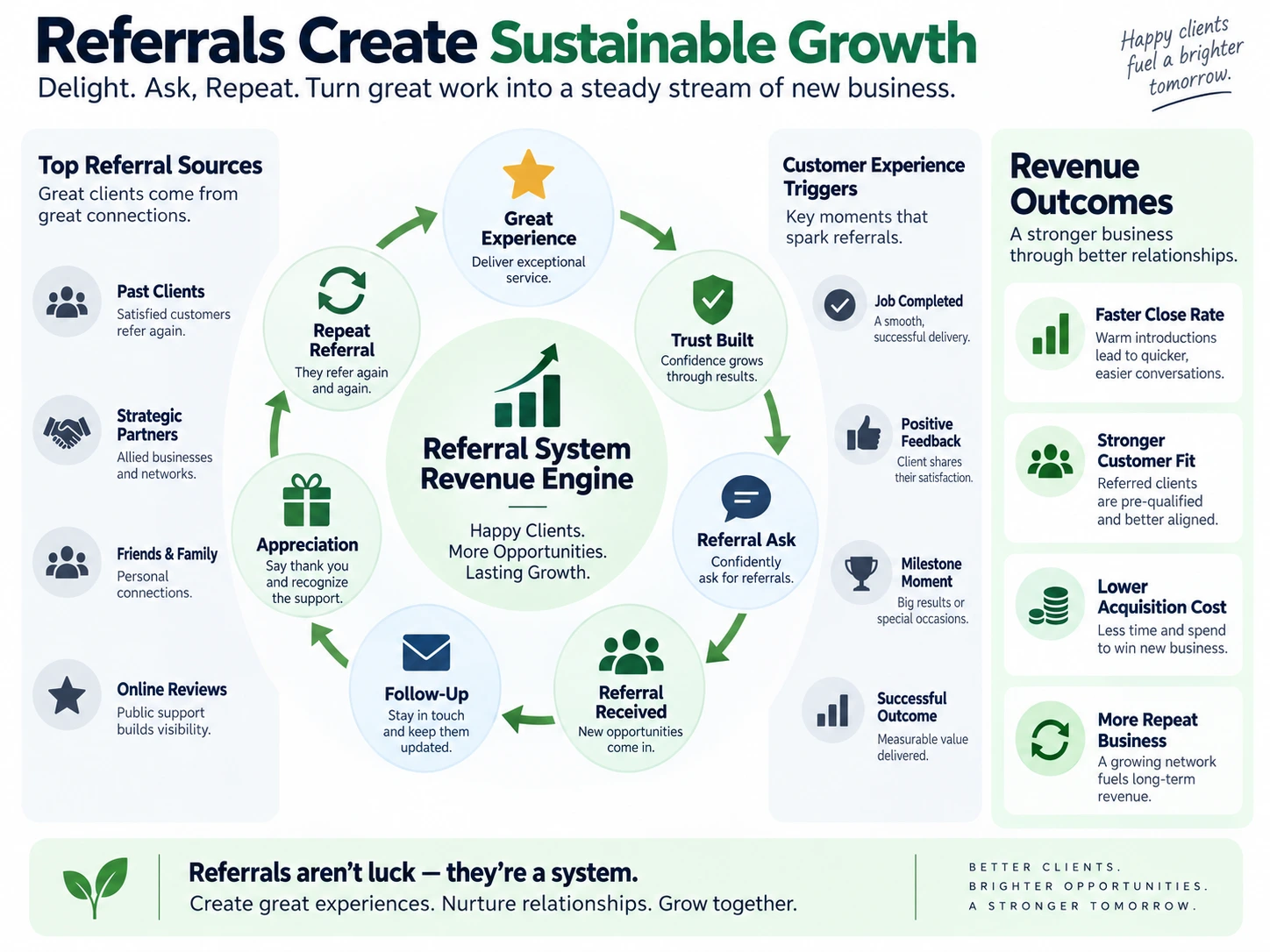
Too many owners say referrals are important while treating them like luck. That makes no sense. If a referral closes faster, carries more trust, and usually produces better-fit customers, then it should be one of the most systematized parts of the business.
You need to know where your best referrals come from, who sends them, what triggers them, and how to make them repeatable. That means tracking, communication, appreciation, and process.
Referrals are not a side benefit. They are a serious revenue stream.
If this is an area your business has underbuilt, check out Ep 39: Referrals and Referral Growth: Long Game 125K Strategy. I also break it down in video form in The Long Game of Referrals and reinforces the same point in Referrals are a Serious Revenue Stream #shorts.
People Buy Outcomes, Not Features
Customers do not buy the thing. They buy what the thing does for them.
They do not buy equipment. They buy uptime. They do not buy marketing. They buy qualified opportunities. They do not buy software. They buy visibility, speed, and control.
This sounds obvious, but most businesses still lead with features because features are easier to describe than outcomes. The problem is that outcomes are what matter commercially. Outcomes are what executives care about. Outcomes are what justify investment.
When your messaging is feature-heavy, you sound like everyone else. When your messaging is outcome-driven, you sound like someone who understands business.
Customer Experience Is Marketing
A lot of owners separate marketing from delivery. That is a mistake.
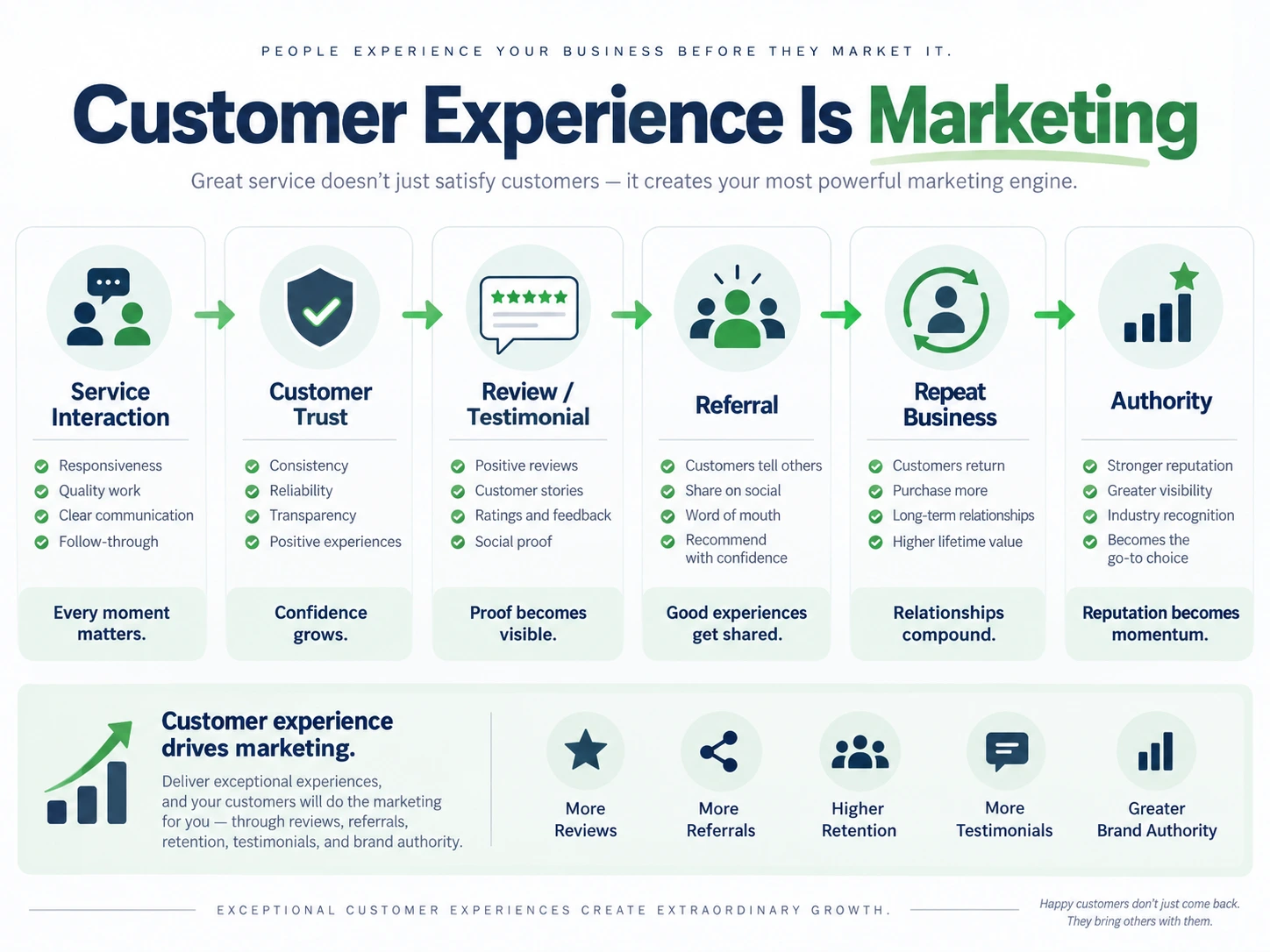
The way a customer experiences your business becomes the story they tell about your business. That story affects retention, reviews, referrals, and future sales. Which means customer experience is not downstream from marketing. It is marketing.
Small moments matter here. How you enter the home. How you communicate. How you prepare the customer. How you follow up. How thoughtful the process feels. Those details shape trust.
Better operators understand that proof marketing is created by the experience itself. If the experience is memorable, respectful, and useful, the next sale gets easier.
For more on building loyalty through experience, read The Art of Customer Retention: Lessons from Vance Morris. I also talk about this operator mindset in Beyond "Just" Marketing: The Power of Operational Excellence for Lifetime Customers and the short The Experience Economy.
Culture Is a Competitive Advantage
Culture is not posters on a wall. It is how the business behaves under pressure.
When a team has clarity around responsibility, accountability, and how people work best, execution improves. Communication improves. Delegation improves. Ownership improves.
That creates a real market advantage because most companies are still trying to scale with confused people, unclear expectations, and reactive leadership. Strong culture reduces friction. Weak culture creates drag.
This is where the business starts paying for weak structure.
If you want to go deeper on team alignment and structured leadership, read The Power of Delegation and Structured Leadership and Discovering the Working Genius.
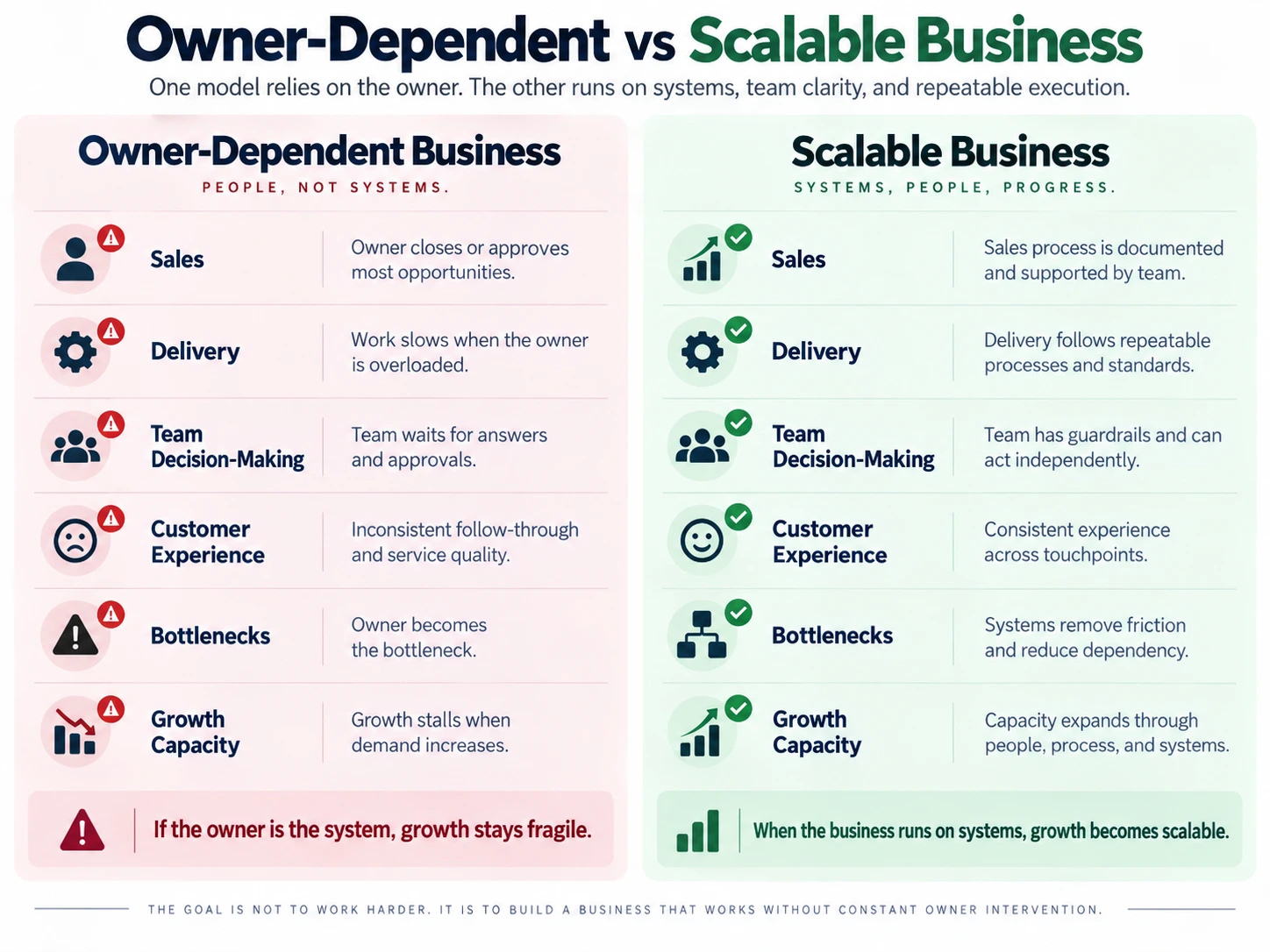
Owner-Dependent Businesses Are Not Scalable
If everything runs through you, you do not have a scalable business. You have a bottleneck with a logo.
Owners love to talk about growth, but many are still central to every decision, every approval, every customer issue, and every handoff. That model does not scale. It breaks.
A scalable business requires systems, delegation, quality control, and operational clarity. The owner can still lead. The owner can still sell. The owner can still shape the market position. But delivery cannot depend on the owner being involved in everything.
That is one of the core distinctions between a business that grows and a business that stays fragile.
I cover this same issue in Scaling Business, Sales Systems, and Entrepreneurship and Can Your Small Business Outsource That?. As well as in Can Your Business Survive 2 Weeks Without You? #shorts and STOP Doing Everything.
Marketing Decisions Need Financial Context
Every marketing decision costs something. Money, time, attention, energy, team bandwidth, opportunity cost. All of it counts.
So if you are going to sponsor something, attend a conference, run ads, rebuild a website, join a mastermind, or push a content strategy, you need financial context around the decision. What is the expected outcome? What is the payback logic? What has to happen for this to be worth it?
That does not mean every initiative needs perfect attribution. It means serious operators do not spend blindly.
Marketing without financial context turns into vanity. Marketing with financial context becomes strategy.
If this is a recurring issue, revisit Why You Can't Afford to Overlook the Hidden Costs of Inaction and Opportunity Cost.
AI Should Amplify Your Voice, Not Replace It
This is the shift that matters now.
AI can absolutely improve efficiency, speed, repurposing, and visibility. But if you use it to flatten your voice, fake your authority, or replace the very thing that makes you credible, you are building the wrong system.
Authority does not come from sounding automated. It comes from being recognizable, useful, and consistently present in the market with a real point of view.
The best use of AI is amplification. It should help you structure ideas, repurpose content, improve reach, and show up where buyers search. It should not erase the operator behind the message.
That is especially true as the podcast evolves into The Authority Hub Podcast. The direction is clear: build authority, make it visible, and use systems to scale that visibility without losing the human voice behind it.
For the next step, watch The AI Free-for-All Is Costing You Money: Build Systems or Stay Stuck and How to Repurpose Your Content. And in shorter form in STOP Using ChatGPT like Google #shorts and Authenticity Beats Ai Fluff.
What Better Operators Do With These Business Lessons From the Podcast
They stop chasing disconnected tactics.
They build systems for follow-up, referrals, customer experience, and content.
They position sales as diagnosis.
They tie marketing to financial outcomes.
They reduce owner dependency.
They use AI to strengthen authority, not manufacture it.
That is what separates a business that looks busy from a business that is actually building leverage.
If you are serious about becoming more visible without becoming more chaotic, this is the right time to tighten the structure. That is exactly where the new Authority Hub direction is going.
If your business has solid expertise but weak visibility, inconsistent follow-up, or too much owner dependency, use these 10 lessons as an audit. Find the bottleneck. Fix the structure. Then build authority on top of that foundation.
Frequently Asked Questions
What are the most important business lessons from the podcast?
The biggest lessons are consistency over creativity, follow-up over lead obsession, sales as diagnosis, referrals as a system, outcomes over features, customer experience as marketing, culture as an advantage, reducing owner dependency, using financial context in marketing, and using AI to amplify your voice.
Why is follow-up more important than getting more leads?
Because weak follow-up wastes existing demand. If the business cannot consistently move prospects through the opportunity cycle, adding more leads usually increases waste instead of revenue.
How do referrals become a real business system?
Track your best referral sources, identify what triggers referrals, create a process for asking, follow up consistently, and build appreciation into the system. Referrals scale when they are managed deliberately.
Why is customer experience considered marketing?
Because the customer experience shapes reviews, retention, referrals, and trust. The way the business is experienced becomes the message the market repeats.
What does it mean that an owner-dependent business is not scalable?
It means the business cannot grow reliably if every decision, approval, or delivery issue has to run through the owner. Scalability requires systems, delegation, and team accountability.
How should business owners use AI without hurting their authority?
Use AI to organize, repurpose, and distribute your expertise. Do not use it to replace your voice or fake credibility. The market still responds to authentic expertise delivered consistently.
Follow these Fundamentals
The 10 business lessons from the podcast are not random observations. They are a playbook for building a business with more leverage, more authority, and less chaos.
If you want the business you actually intended to build, start with these fundamentals. Consistency. Follow-up. Referrals. Outcomes. Experience. Culture. Systems. Financial clarity. Authentic authority.
Everything else gets easier when those are in place.
Connect With Bryan Durkin
Follow Bryan Durkin on Facebook
Connect with Bryan Durkin on LinkedIn
Subscribe to Bryan Durkin on YouTube
Listen to Bryan Durkin on Spotify
